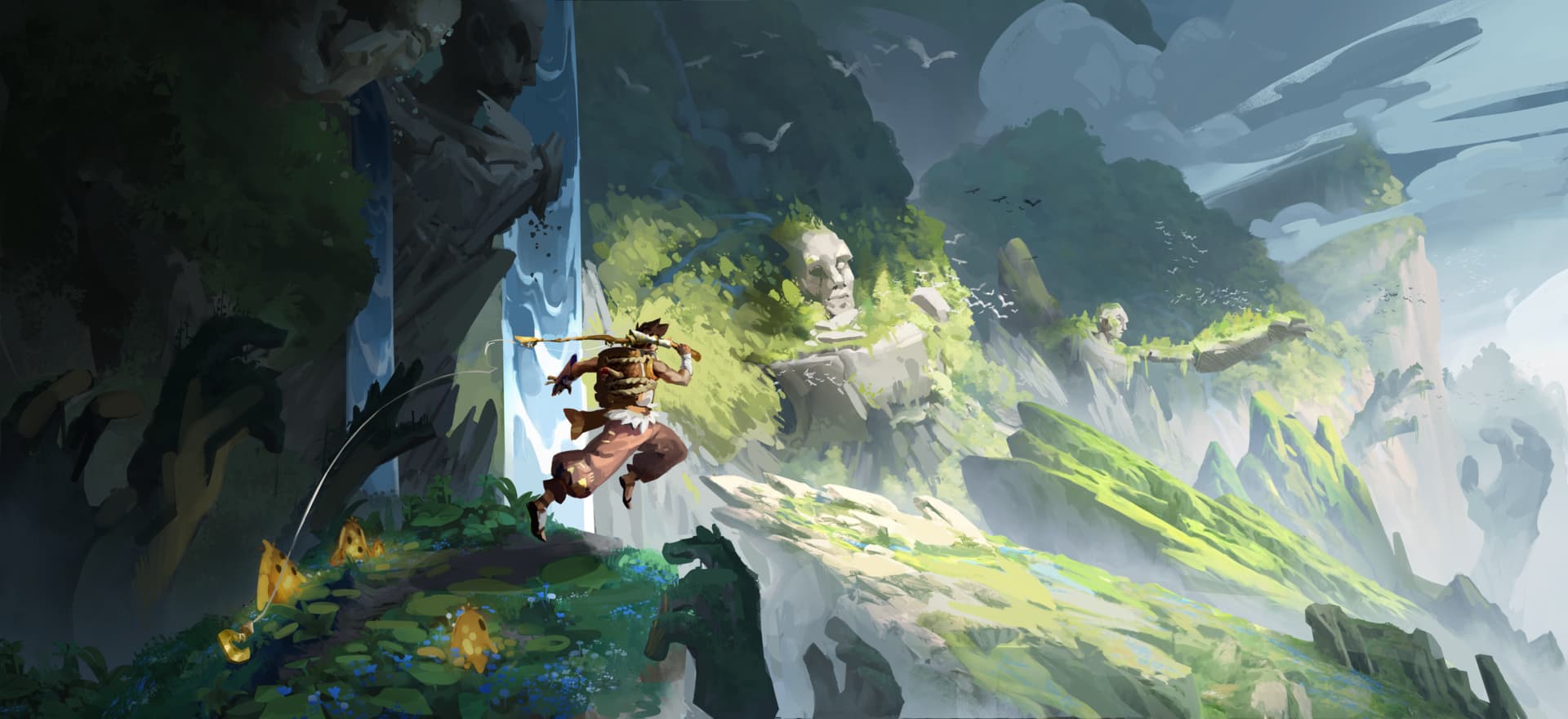
ALEMOS: Mist of the Highlands
Role : Co-founder and Game Designer
Gameplay, UX & Narrative
A renowned adventurer is called to Alemos, a cold and forgotten island at the edge of the world, where strange calamities now threaten its inhabitants.
His journey leads him across a land frozen in time, between ruins overrun with moss, canyons drowned in mist and the colossal remains of Giants melded into the landscape.
As he pushes deeper into the heart of Alemos, his mission takes on an entirely different dimension and reveals an ancient conflict binding the island to its people for generations.
Born in July 2024, this project has mostly moved forward on our team's free time, alongside our day jobs; we are now a core team of 10.
Our current goal is a trailer presenting the game's overall mood, its universe, its art direction and a few glimpses of the gameplay we have planned.
A heroic fisherman
Le Coloriste, our main character, is inspired by Gon (Hunter x Hunter) and by Link (Zelda); he carries a fishing rod and wants to play his part in the stability of the world order.
My first challenge was facing the affordance: my main character was going to have to fish...
So I was looking for a place for fishing (as an activity). I explored a few avenues, from the most basic — Animal Crossing, where the experience stops at a simple timing game — to the most narratively deep: a mirror of the character's state as he progresses through the story, through the exploration of paintings, more artistic.
I finally decided to bring fishing into the game as a gameplay element, simple on the surface but true to the essence of fishing: surprise. An unexpected answer to a problem the player will meet later in the game. Until then the player can fish without seeing any immediate benefit, as a light, gimmicky action he can make his own.
Accessibility, onboarding and immersion
From the very start of the project I set as a design pillar the maximisation of how quickly anyone can pick the game up. It was by centralising interactions around a single button and a single tool, the fishing rod, that I found a good balance. Here are a few examples:
- A grappling hook inspired by Sekiro's, answering a more vertical and precise approach to space. I knew the game would have a section with canyons, gaining height as you near the summit... This tool seemed perfectly suited to at least start prototyping and identify other, more specific needs for the project later on.
- The ability to strike with the rod as with a staff. This simple action reinforces the swiss-army-knife approach and anchors the character to his fishing rod, since he even comes to consider it the best answer in a physical conflict.
- Leaning on the rod like a pole during a jump to gain height or distance. Quite similar to striking: it is the extension of a habitual behaviour through his tool, while underlining the character's athletic side, a trait we wanted to bring forward.
A few other avenues were explored then set aside because of the problems they raised, such as: using Unreal's native physics through our very free throwing system.
- What to do with an object thrown somewhere unreachable? How to handle its respawn?
- if it can be thrown, it has a collision, if the player decides to stack them, he could then climb anywhere...
Through the Link reference, the question of combat in the game came up quickly, but the more narrative and contemplative traits of the game made it so - in correlation with our desire for ease of use - to aim for an extremely simplified combat system, no health bar or anything else, we aim for maximum immersion.
Managing the pace and distribution of information
A challenge from our shared background in cinema was determining how to properly distribute information. The game being one of exploration, we were looking to ensure both continuity of storytelling and a pronounced sense of freedom.
This is how I proposed the implementation of 2 things:
- A golden path that structures the adventure and a “baseline” rhythm accompanied by fragments of lore to be discovered while exploring, which drives curiosity.
- A document that recaps the stories, the information and their exposure value, the probability of crossing their path, a powerful guide for our level designer.
The last thing we needed was a document that would help us align better, and more clearly identify the appealing idea that highlights and contributes to the experience as we imagined it.
Our creative director already had a good idea of the story's broad strokes, so I took a scene-by-scene approach: the step-by-step experience document.
- This document describes: the events, the player's short, medium and long term objectives scene by scene, and above all the experience intentions along with the solutions already planned to reach them, both artistically and in gameplay.
- Each experience could then be measured and assessed against the solutions put in place, securing the road to prototyping.