Inn Piling Up Challenge
Role : Game Designer & Developer
Context
Second GameJam, this time as a duo. The concept: pile up as many objects as possible inside an inn. My technical focus for this Jam was Chaos Destruction - UE5's asset destruction system - with the goal of understanding concretely how it works and where its limits are. The short Jam format kept my exploration at surface level, but enough to grasp the fundamentals.
First duo: between mentoring and making
My partner was very much a beginner - I started by understanding what she was looking to get out of the Jam so I could make sure her experience matched her expectations. In practice, that meant dedicating significantly more time than anticipated to helping her through her tasks. More than I had planned for, and it had a direct impact on what I was able to build on my side.
In the end, she made real technical progress and I learned a lot about leadership - specifically how to calibrate support based on someone's level and intentions.
Chaos Destruction: surface exploration
Chaos is UE5's physics-based destruction system - it allows assets to fracture into pieces that react to applied forces. What interested me: understanding how it actually works, what its limits are, and what it opens up in terms of gameplay and visual feedback.
The Jam was too short for a deep exploration - I was able to grasp the core mechanics and validate that the system was interesting, without pushing it to its limits. It's a tool I plan to revisit in a more open context.
The laser as a dynamic objective
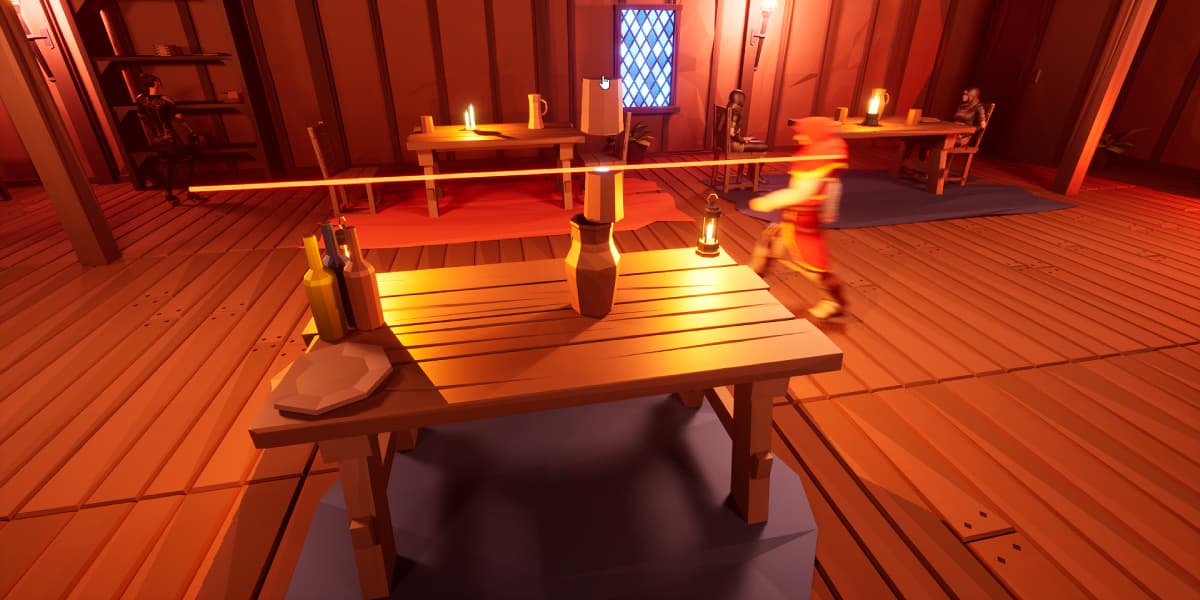
The beginning of the game is intentionally open - the player piles up objects without an immediate constraint. To give a clear, space-anchored objective, I introduced a laser indicating the maximum height to reach. Its key property: it positions itself dynamically anywhere in the room, which required it to be readable and placeable without manual intervention.
This is an example of functional design first - the indicator exists because the gameplay needed it, not for aesthetic reasons.